HealthFounderOS: The Single Brain for Healthcare AI
A CEO Field Guide for Moving from Scattered AI Tools to Governed Healthcare Workflows
Publication Note
This ebook is an original HealthFounderOS adaptation inspired by the public OpenExO / Organizational Singularity framework and specialized for healthcare growth, operations, governance, and compliance-aware AI adoption. It is not a substitute for legal, regulatory, clinical, privacy, reimbursement, or medical advice. Healthcare organizations should involve qualified counsel, compliance leaders, privacy officers, clinical leaders, and executive decision-makers before deploying AI into regulated workflows.
HealthFounderOS is designed for commercial operations, customer experience, marketing/sales enablement, workflow design, governance, and executive alignment. It is not medical advice, diagnosis, treatment, or clinical decision support.
Executive Summary
Healthcare organizations do not need more AI tools.
They need a governed AI operating model.
Over the last two years, healthcare teams have moved from curiosity to experimentation. CEOs are using ChatGPT or Claude for strategy. Commercial teams are generating launch plans, segmentation, account lists, outreach sequences, investor narratives, patient education drafts, and competitive scans. Junior teammates are suddenly more productive. Advisors are producing faster memos. Agencies are delivering more decks. Legal and compliance teams are receiving AI-assisted interpretations. Everyone has access to intelligence.
That is the breakthrough.
It is also the problem.
The first wave of AI adoption in healthcare is creating fragmented intelligence:
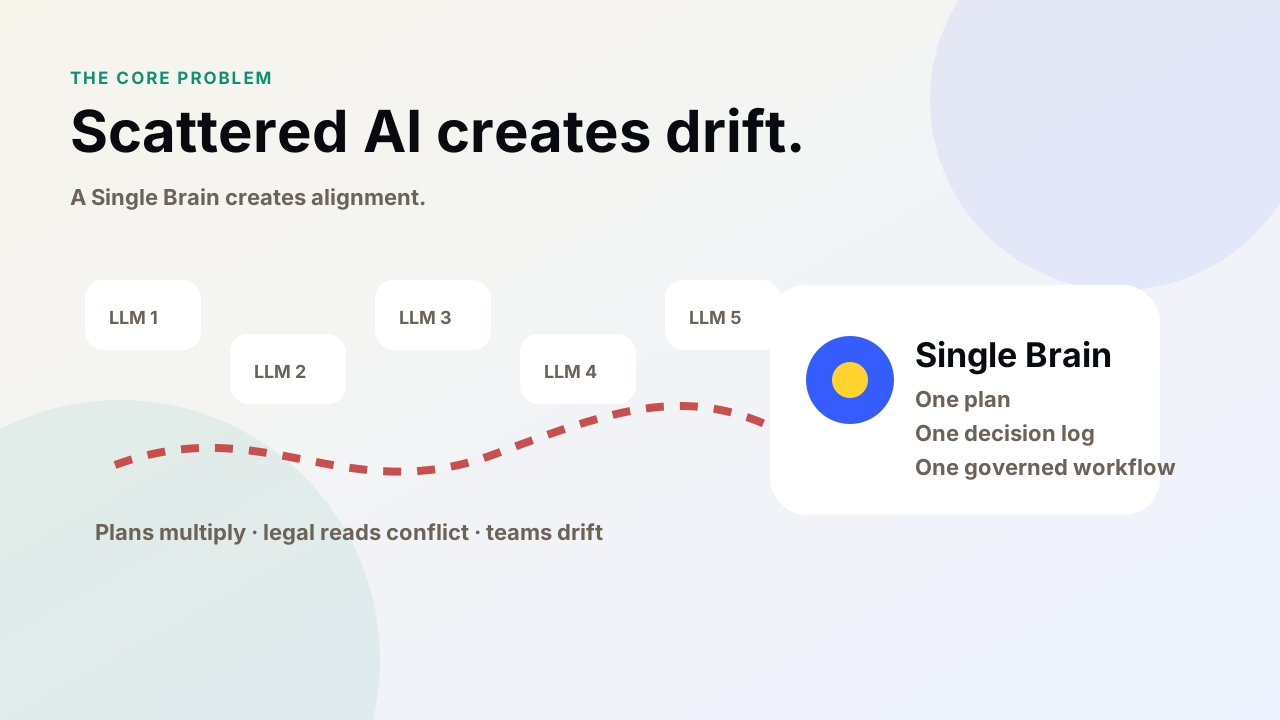
- Multiple plans, but no single aligned plan.
- Faster content, but more AI slop.
- More confident recommendations, but less strategic discipline.
- Junior teammates empowered by sycophantic LLMs that sound right while moving off strategy.
- “Dueling LLM email wars” where one person’s model battles another person’s model instead of resolving to a company decision.
- Multiple legal interpretations producing disagreement, discomfort, and avoidable risk.
- CEOs with major blind spots using AI to produce more decisions without installing better governance.
- Frequent executive pivots creating more work than the organization can absorb.
- Resistance from teammates who do not want to give up their individual AI superpowers in exchange for a shared company brain.
- Pre-launch planning collapsing into premature commercial claims before legal approval, MLR-style review, or regulated launch discipline is ready.
In healthcare, this drift is not a small inconvenience. It affects growth, governance, compliance posture, team trust, customer experience, investor confidence, and operational execution.
The core HealthFounderOS thesis is simple:
When intelligence becomes cheap, alignment, governance, and accountability become the scarce assets.
The healthcare company of the next decade will not win because it bought the most AI subscriptions. It will win because it installed a Single Brain: a governed, human-accountable, compliance-aware AI operating system that can convert strategy into workflows, workflows into decisions, and decisions into measurable execution.
OpenExO’s Organizational Singularity framework describes a shift from traditional firms built around human coordination costs toward AI-native organizations built around intelligence density. HealthFounderOS adapts that logic for healthcare companies, where growth has to move fast but cannot outrun compliance, privacy, clinical boundaries, claims discipline, or human accountability.
HealthFounderOS has three core moves:
- Destination: Define the healthcare AI operating model — mission, growth objectives, constraints, human accountability, and the desired future state.
- Operating System: Build the Single Brain — the governed intelligence stack that connects data, context, workflows, agents, decisions, approvals, and execution.
- Playbook: Install one governed workflow at the edge of the business, prove value, and scale what works.
This field guide gives CEOs and executive teams a practical way to make that shift: start with one important workflow, govern it properly, prove value, and expand with discipline.
Forward Deployed Growth Roles
The rise of Forward Deployed Engineers creates an equal need for Forward Deployed Marketers and Forward Deployed Sales agents.
A Single Brain is not just a knowledge base. It is the shared operating memory that lets commercial operators and technical builders work from the same strategy, customer context, assets, decisions, prompts, rules, and review process.
Forward Deployed Marketer
The Forward Deployed Marketer understands the business model, customer, market, message, offer, funnel, content engine, and sales motion. This operator turns the Single Brain into marketing strategy, campaigns, content, lifecycle motions, and go-to-market execution.
Forward Deployed Sales agent
The Forward Deployed Sales agent turns the Single Brain into pipeline action: account preparation, outreach, follow-up, objections, service workflows, CRM discipline, and revenue cadence. This role keeps sales execution connected to the same operating memory as marketing, leadership, and service.
Forward Deployed Engineer
The Forward Deployed Engineer grounds strategy in technical reality, builds the systems, and brings implementation ideas back into the commercial loop.
The future healthcare growth team is not marketing over here, sales over there, engineering somewhere else, and AI tools scattered everywhere. It is a governed Single Brain, a HealthFounderOS harness, and a forward-deployed growth loop that turns strategy into deployed workflows.
The Three Things to Remember
The HealthFounderOS model can be reduced to three ideas.
1. Destination: The Healthcare AI Operating Model
The destination is not “everyone uses AI.”
The destination is a healthcare organization where AI is embedded into the operating model without eroding compliance, accountability, or strategic coherence.
That means every AI workflow must know:
- What mission it serves.
- What commercial outcome it supports.
- What data it may use.
- What claims it may or may not make.
- What decisions require human approval.
- What legal, privacy, clinical, reimbursement, and brand constraints apply.
- What success metrics matter.
- What failure modes must be avoided.
In OpenExO terms, this is the destination architecture. In HealthFounderOS language, it is the move from scattered AI tools to a governed healthcare operating model.
2. Operating System: The Single Brain
The Single Brain is not one model, one chatbot, or one vendor.
It is the shared intelligence layer that keeps the company aligned:
- One strategy.
- One source of truth.
- One approved positioning system.
- One claims and compliance boundary.
- One decision log.
- One workflow map.
- One governed way for humans and AI agents to work together.
Individual AI superpowers feel powerful at first. But when every teammate has a private model, private prompts, private assumptions, and private interpretations, the company does not become smarter. It becomes louder.
A Single Brain creates compounding intelligence instead of dueling intelligence.
3. Playbook: Start Small, Govern It, Prove Value, Scale What Works
Healthcare AI programs lose momentum when they begin as broad, undefined enterprise transformation projects.
HealthFounderOS begins at the edge:
- One commercially valuable workflow.
- Clear human owner.
- Defined data boundaries.
- Approved message and claims rules.
- Legal/compliance review pathway.
- Success metrics.
- Decision log.
- Operating cadence.
The first strategic blueprint becomes the prototype for the organization’s AI operating system.
Do not begin by asking, “What AI tools should we buy?”
Begin by asking:
Where do growth, operations, and governance most urgently need leverage — and what is the first strategic blueprint we can safely govern, prove, and scale?
Part I — Why Healthcare AI Adoption Breaks
Chapter 1 — The Asteroid: Intelligence Is Now Cheap
AI has collapsed the cost of many tasks that used to require scarce human time:
- Drafting.
- Summarizing.
- Researching.
- Comparing documents.
- Creating plans.
- Producing outreach.
- Generating education content.
- Translating strategy into tasks.
- Reviewing contracts or policy language.
- Building first-pass workflows.
- Creating customer journeys.
For healthcare companies, this is extraordinary. A small team can now do work that previously required a strategist, analyst, copywriter, project manager, market researcher, compliance coordinator, and operations lead.
But cheap intelligence is not the same as governed intelligence.
A junior team member can produce a beautiful plan that is completely wrong. A CEO can generate an impressive new strategy that ignores months of team alignment. A legal interpretation can sound authoritative while missing the practical regulatory context. A marketing sequence can be persuasive but make claims the company cannot support. A launch plan can sound commercially exciting while violating the difference between pre-launch education and true legally approved commercial promotion.
The asteroid is not just AI capability.
The asteroid is the sudden arrival of intelligence without the operating model required to control it.
Chapter 2 — Why Traditional Healthcare Teams Struggle
Traditional healthcare organizations were built around controlled coordination:
- Executives set direction.
- Functional leaders interpret the plan.
- Legal/compliance approves boundaries.
- Commercial teams execute.
- Operations manages workflow.
- Clinical or scientific leaders protect accuracy.
- Agencies support execution.
This system was slow, but the slowness created friction. That friction forced review, debate, revision, and approval.
AI removes much of the friction.
That can be good. But in regulated healthcare, some friction is protective. The goal is not to eliminate governance friction. The goal is to replace random friction with designed governance.
The first wave of healthcare AI adoption often fails in predictable ways.
Failure Mode 1: AI Superpower Hoarding
Every teammate discovers a personal workflow. Someone builds prompts for sales. Someone else uses Claude for launch plans. Another person uses ChatGPT for reimbursement research. An advisor uses a different model for strategic memos. A founder uses another AI workspace for investor messaging.
People become attached to their private AI advantage.
Then the CEO says: “We need one shared AI brain.”
Resistance appears immediately.
Why? Because teammates feel they are being asked to give up speed, autonomy, creativity, and status.
HealthFounderOS treats this as an adoption problem, not a personality problem. The answer is not to ban personal AI. The answer is to define which work can happen privately and which work must migrate into the governed Single Brain.
Failure Mode 2: Numerous Plans, No Single Aligned Plan
AI makes planning cheap.
That creates a flood of plans:
- Growth plans.
- Launch plans.
- Investor plans.
- Content plans.
- Sales plans.
- Partnership plans.
- Clinical education plans.
- Compliance plans.
- Agency plans.
The problem is not lack of planning. The problem is lack of decision architecture.
Without a Single Brain, plans compete rather than converge. The organization keeps generating new documents instead of committing to one approved operating plan.
Failure Mode 3: AI Slop in Strategic Work
AI slop is not just bad writing.
In healthcare strategy, AI slop includes:
- Generic claims that could apply to any company.
- Overconfident recommendations without evidence.
- Vague action plans with no owner or cadence.
- Strategy words that sound smart but do not change behavior.
- Patient-centered language that is emotionally polished but clinically or legally imprecise.
- Commercial suggestions that ignore real reimbursement, regulatory, privacy, or claims constraints.
AI slop is dangerous because it often looks professional.
HealthFounderOS requires taste, judgment, and human accountability at the review layer. AI can draft, synthesize, compare, and accelerate. It should not define strategy without approved context, evidence, constraints, and executive decision rights.
Failure Mode 4: Junior Team Overconfidence
LLMs are often agreeable. They can make a junior teammate feel validated, empowered, and correct even when the output is off strategy.
This creates a new management problem.
The teammate is not lazy. They may be working harder than ever. But the feedback loop is broken. The AI tells them the work is strong. The plan looks polished. The teammate feels ownership.
Then the CEO or senior operator has to unwind work that was never aligned.
HealthFounderOS solves this by making the shared context stronger than the model’s default sycophancy. The model should be forced to work inside the company’s approved mission, positioning, constraints, operating plan, and review standards.
Failure Mode 5: Dueling LLM Email Wars
A new pattern is emerging:
- One person drafts an argument with their LLM.
- Another person responds with their LLM.
- A third person uses another model to critique both.
- The CEO forwards a new AI-generated framing.
- Legal sends a different interpretation.
- The agency generates a polished counterproposal.
Suddenly, the team is not debating the business. The team is debating artifacts generated by competing AI systems.
This creates misalignment, disagreement, drift, and wasted time.
The antidote is a governed decision process:
- What is the decision?
- Who owns it?
- What evidence matters?
- What constraints apply?
- Who must approve?
- Where is the final decision logged?
- What work changes because of the decision?
A Single Brain does not eliminate debate. It prevents debate from fragmenting the company.
Failure Mode 6: No Absolute Decision-Maker
AI makes it easier to generate options than to make decisions.
Healthcare companies cannot operate forever in option mode. They need a clear decision-maker for commercial, operational, legal, clinical, and strategic questions.
“Let’s ask the AI” is not governance.
The organization needs decision rights:
- CEO decisions.
- Legal/compliance decisions.
- Clinical/scientific decisions.
- Commercial decisions.
- Operational decisions.
- Brand/message decisions.
- Data/privacy decisions.
HealthFounderOS makes decision ownership explicit.
Failure Mode 7: CEO Blind Spots at Machine Speed
AI can amplify a CEO’s strengths.
It can also amplify a CEO’s blind spots.
A CEO under pressure can now generate more ideas, more pivots, more strategic documents, and more instructions than the team can absorb. Without governance discipline, AI can outrun legal, compliance, operations, and commercial reality. Without phase discipline, AI can produce promotional language before the company is ready to use it.
In the old model, the CEO’s capacity limited the blast radius.
In the AI-native model, ungoverned executive output can create organizational drift faster.
HealthFounderOS reframes the CEO role: not prompt-master or content engine, but Exponential Growth Officer — the human purpose holder, decision-maker, and governance sponsor for the company’s Single Brain.
Failure Mode 8: Legal Interpretations Without Alignment
Healthcare companies often face legal ambiguity:
- What can we say before approval?
- What claims are supportable?
- What is education versus promotion?
- What requires MLR-style review?
- What data can be used?
- What creates privacy risk?
- What creates reimbursement or inducement risk?
- What is appropriate for patients, providers, investors, or partners?
AI can produce multiple plausible interpretations. Different team members may return with different answers. The result is discomfort, disagreement, delayed execution, or accidental violation.
HealthFounderOS does not replace counsel. It structures counsel’s decisions into operating rules the team can follow.
The goal is not “AI legal advice.”
The goal is an approved legal/compliance boundary layer inside the operating system.
Failure Mode 9: Collapsing Pre-Launch into Commercial Launch
Healthcare organizations must respect phases.
Pre-launch planning is not the same as commercial promotion. Market education is not the same as product claims. Investor narrative is not the same as patient acquisition. Scientific education is not the same as sales enablement.
AI blurs these lines because it can instantly produce polished assets for every audience.
HealthFounderOS protects phase discipline:
- Strategic planning.
- Evidence and claims mapping.
- Legal/compliance boundary setting.
- Pre-launch education.
- Internal readiness.
- Approved commercial launch.
- Post-launch measurement and iteration.
The faster AI gets, the more important phase discipline becomes.
Part II — What Replaces Scattered AI
Chapter 3 — The HealthFounderOS Destination Architecture
OpenExO describes ExO 3.0 as a destination architecture built around MTP, DRIVE, and SHAPE.
HealthFounderOS adapts this into a healthcare-specific operating architecture:
- MTP — Mission as Protocol
- DRIVE — The Growth and Intelligence Engine
- SHAPE — The Human-Agent Operating Form
Together, these define the destination: a healthcare organization where AI is not a side tool, but a governed operating system.
MTP — Mission as Protocol
Most healthcare companies have mission statements.
Few have mission protocols.
A mission statement says what the company believes.
A mission protocol tells the organization how to act.
For HealthFounderOS, the mission must be encoded into the AI operating system:
- Who we serve.
- What outcomes we support.
- What we will not claim.
- What patient, provider, partner, or customer promises we can support.
- What regulatory, legal, and ethical boundaries apply.
- What commercial strategy is approved.
- What language is patient-centered and compliant.
- What decisions must remain human.
The mission becomes executable.
DRIVE — The Growth and Intelligence Engine
DRIVE is the intelligence engine that converts signals into action.
In healthcare growth, relevant signals may include:
- CRM data.
- Referral patterns.
- Website engagement.
- Scorecard submissions.
- Sales calls.
- Market access signals.
- Provider feedback.
- Patient or customer education gaps.
- Competitive intelligence.
- Investor questions.
- Claims and compliance feedback.
- Content performance.
- Operational bottlenecks.
A governed DRIVE layer helps teams move from “we have information” to “we know what to do next.”
It routes, drafts, prioritizes, flags risk, recommends next actions, and updates the decision log.
But DRIVE must be governed. An unguided growth engine becomes a content cannon.
SHAPE — The Human-Agent Operating Form
SHAPE defines how people and AI agents work together.
The question is no longer: “Which tasks can AI do?”
The better question is:
What should the organization look like now that AI can participate in planning, analysis, communication, workflow, and decision support?
In HealthFounderOS, the operating form includes:
- CEO as purpose holder and final commercial decision-maker.
- Legal/compliance as boundary authority.
- Clinical/scientific experts as evidence and accuracy authorities.
- Operators as workflow owners.
- AI agents as draft, synthesis, routing, and monitoring partners.
- A shared Single Brain as the alignment layer.
The org chart does not disappear. It becomes clearer.
Chapter 4 — The Healthcare Intelligence Stack
A healthcare AI operating system needs a stack, not a pile of tools.
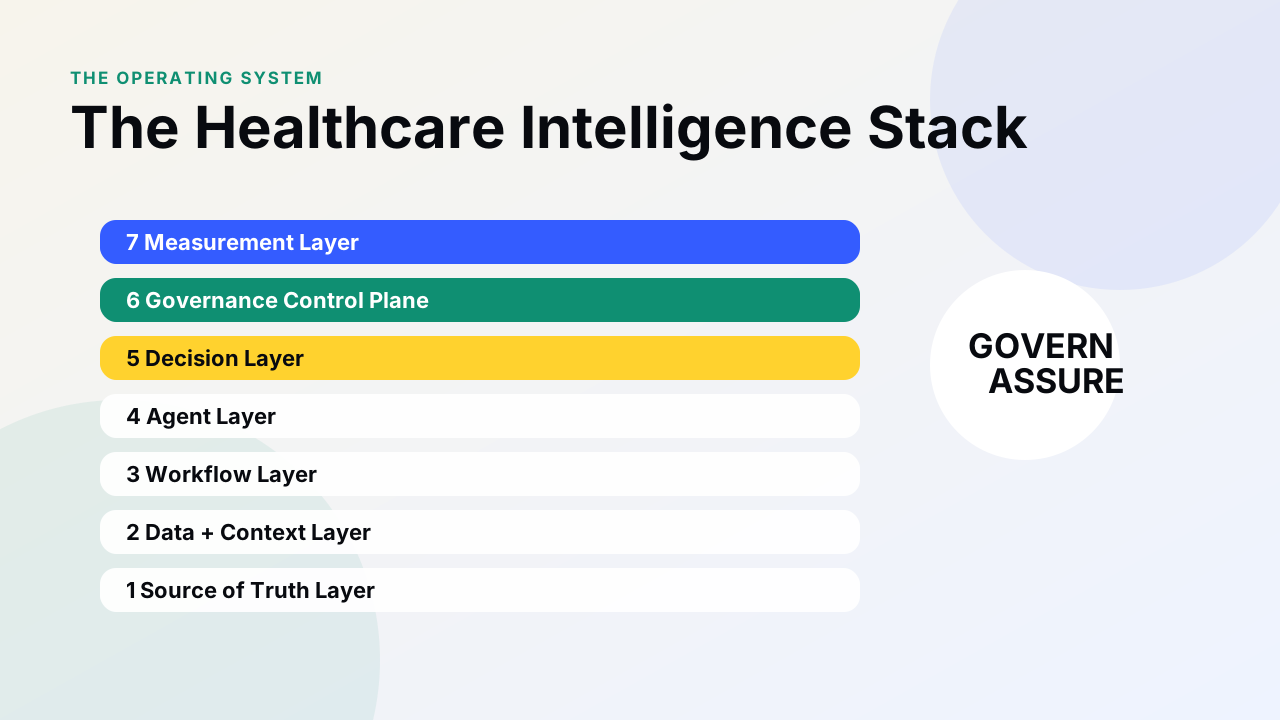
A practical HealthFounderOS Intelligence Stack has seven layers.
Layer 1: Source-of-Truth Layer
This is where approved knowledge lives:
- Positioning.
- Product descriptions.
- Market definitions.
- Claims boundaries.
- Legal/compliance rules.
- Audience-specific messages.
- SOPs.
- Approved offers.
- Commercial priorities.
- Customer/prospect intelligence.
- Meeting decisions.
- Launch phase status.
Without a source-of-truth layer, AI creates infinite plausible versions of the company.
Layer 2: Data and Context Layer
This layer governs what AI can see:
- What data is allowed.
- What data is prohibited.
- What contains PHI or sensitive data.
- What requires de-identification.
- What is confidential.
- What can be used for public content.
- What should remain internal.
For many healthcare companies, AI failure begins here. The issue is not the model. It is data ambiguity.
Layer 3: Workflow Layer
This layer defines repeatable work:
- Intake.
- Research.
- Drafting.
- Review.
- Approval.
- Follow-up.
- Reporting.
- Escalation.
- Measurement.
AI should be native to workflows, not floating above them as a chatbot.
Layer 4: Agent Layer
Agents should have jobs, not personalities.
Examples:
- Research agent.
- Intake agent.
- Follow-up agent.
- Compliance-screening assistant.
- Commercial planning assistant.
- Meeting intelligence assistant.
- Content repurposing assistant.
- Scorecard triage assistant.
Each agent needs a scope, inputs, outputs, boundaries, escalation rules, and human owner.
Layer 5: Decision Layer
This is where many healthcare AI deployments break.
The organization must define:
- What AI can recommend.
- What AI can draft.
- What AI can route.
- What AI can publish.
- What AI can never decide.
- Who approves exceptions.
- Where final decisions are logged.
The decision log becomes one of the company’s most valuable assets. It captures not just what the company decided, but why.
Layer 6: Governance Layer
Governance is not a compliance afterthought. It is the control plane.
For healthcare, governance includes:
- Privacy boundaries.
- Claims rules.
- Promotional review.
- Clinical accuracy review.
- Legal approval.
- Role-based access.
- Audit logs.
- Vendor/tool risk review.
- Human-in-the-loop rules.
- Data retention and deletion rules.
- Escalation pathways.
Governance should make good work faster, not slower.
Layer 7: Measurement Layer
AI adoption must be measured by business outcomes, not token usage or tool enthusiasm.
Useful HealthFounderOS metrics may include:
- Lead lift.
- Engagement lift.
- Conversion lift.
- Response time reduction.
- Follow-up completion.
- Content approval cycle time.
- Sales cycle velocity.
- Meeting-to-action conversion.
- Reduction in duplicate plans.
- Reduction in legal rework.
- Increase in approved workflow adoption.
- Reduction in off-strategy content.
The organization should measure whether the Single Brain improves execution, not whether people are “using AI more.”
Part III — The Vertical Rewrite in Healthcare
Chapter 5 — The CEO: From Bottleneck to Purpose Holder
The AI-native healthcare CEO cannot let prompt volume substitute for executive discipline.
The CEO’s job is to hold purpose, set priorities, allocate capital, resolve decisions, and sponsor governance.
This requires discipline.
The CEO must stop using AI to generate endless new directions and start using AI to strengthen alignment.
The CEO’s New Responsibilities
- Define the company’s AI ambition.
- Name the first strategic blueprint that matters.
- Clarify decision rights.
- Approve the source-of-truth layer.
- Protect phase discipline.
- Resolve dueling interpretations.
- Prevent frequent strategic pivots from overwhelming execution.
- Ensure compliance and human accountability remain explicit.
A CEO with AI can move faster.
A CEO with a Single Brain can move the company faster.
Chapter 6 — The Middle Layer: From Coordinator to Exception Architect
Middle managers and functional leaders are not obsolete.
Their work changes.
Instead of coordinating every task manually, they design workflows, monitor exceptions, improve the system, and protect quality.
In a HealthFounderOS company, the middle layer asks:
- What should be automated?
- What should be drafted?
- What should be routed?
- What should be escalated?
- What requires human judgment?
- What risks are emerging?
- What workflow is breaking?
- What does the decision log show?
The middle layer becomes the exception architecture.
Chapter 7 — The Front Line: From Task Executor to Agentic Operator
Junior teammates should not be told to stop using AI.
They should be trained to use AI inside the company operating system.
The difference matters.
A task executor waits for instructions.
An agentic operator can:
- Use approved context.
- Draft within constraints.
- Identify ambiguity.
- Escalate risk.
- Improve workflows.
- Update the Single Brain.
- Measure results.
This is how AI empowerment becomes organizational capability rather than individual chaos.
Part IV — How to Get There
Chapter 8 — What To Do With Your Data
The most common AI failure is not the model.
It is the data and context layer.
Healthcare companies often have critical knowledge scattered across:
- Google Drive.
- Slack.
- Email.
- CRM.
- EHR-adjacent systems.
- PDFs.
- Decks.
- Legal memos.
- Agency documents.
- Board materials.
- Founder notes.
- Meeting transcripts.
- Website pages.
- Product one-pagers.
- Regulatory documents.
A Single Brain requires a governed knowledge architecture.
The HealthFounderOS Data Questions
Before deploying AI into any workflow, answer:
- What is the authoritative source of truth?
- What data is approved for AI use?
- What data is restricted, confidential, or PHI-adjacent?
- What can be used in public content?
- What requires legal/compliance review?
- What must never be uploaded into public tools?
- Who owns each knowledge domain?
- How are decisions logged and updated?
- How does the team know when source material has changed?
- How do we retire outdated context?
Without these answers, AI accelerates confusion.
Chapter 9 — The Edge Deployment Model
Do not start with enterprise transformation.
Start at the edge.
The edge is a workflow close enough to value that improvement matters, but bounded enough that governance is realistic.
Examples:
- Scorecard intake and follow-up.
- Referral outreach sequence.
- Sales call prep.
- Investor update production.
- MLR-ready content drafting.
- Customer education workflow.
- CRM cleanup and account prioritization.
- Partnership target research.
- Meeting intelligence to action items.
- Pre-launch claims boundary mapping.
The first edge deployment should have:
- A human owner.
- A clear business outcome.
- A defined audience.
- Approved source material.
- Data boundaries.
- Legal/compliance review rules.
- Success metrics.
- A weekly operating cadence.
Edge deployment is not small thinking. It is how healthcare companies avoid betting the company on vague AI transformation.
Chapter 10 — The REWRITE Playbook for Healthcare AI Adoption
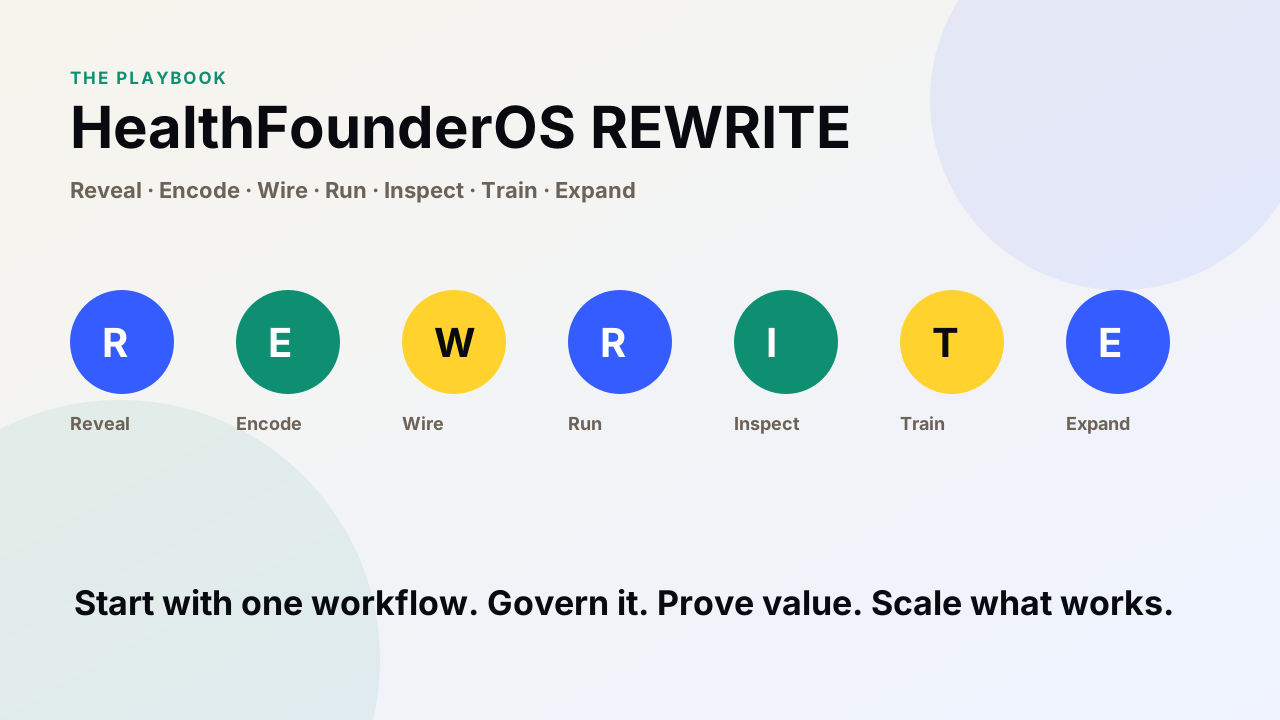
A practical healthcare AI adoption sequence should help leadership move from abstract ambition to governed execution:
R — Reveal the Real Workflow
Map how work actually happens today.
Not the org chart. Not the process deck. The real workflow.
Where do requests enter? Where do they stall? Where does legal get involved? Where does the CEO override? Where do junior teammates use private AI? Where do plans multiply? Where does compliance uncertainty stop momentum?
E — Encode the Mission, Constraints, and Decision Rights
Turn mission into protocol.
Define:
- Approved positioning.
- Audience-specific language.
- Claims boundaries.
- Phase discipline.
- Legal/compliance decision rights.
- Human approval points.
- Data boundaries.
- Success metrics.
W — Wire the Single Brain
Connect the source-of-truth layer, data/context layer, workflow layer, agent roles, governance rules, and decision log.
This does not require a giant software build. It can begin with a well-structured knowledge base, clear operating cadence, and governed AI workspace.
R — Run the Edge Pilot
Choose one workflow and run it.
The goal is not to demonstrate that AI can produce drafts. Everyone knows that now.
The goal is to prove that governed AI can improve a real business workflow without creating drift or compliance discomfort.
I — Inspect the Exceptions
Review what broke:
- What outputs were off strategy?
- Where did the model hallucinate?
- Where did legal disagree?
- Where did teammates resist?
- Where did executive direction change faster than the workflow could absorb?
- Where did source-of-truth gaps appear?
- Where did the workflow need human judgment?
Exceptions are not failures. They are design inputs.
T — Train the Human-Agent Partnership
Train the team on the new operating model:
- How to use the Single Brain.
- How to draft with approved context.
- How to escalate uncertainty.
- How to avoid dueling LLM wars.
- How to update the decision log.
- How to respect launch phases.
- How to turn AI outputs into reviewed work.
E — Expand What Works
Only scale after the workflow is governed and measured.
Then move to the next workflow.
The sequence is:
Start with one workflow. Govern it. Prove value. Scale what works.
Part V — Governance, Compliance, and Phase Discipline
Chapter 11 — The Healthcare Governance Operating Layer
In healthcare AI adoption, governance cannot be a policy document that sits outside the work. It has to be embedded into the way work gets requested, drafted, reviewed, approved, measured, and improved.
A useful governance layer should answer:
- What can AI do autonomously?
- What requires human review?
- What requires legal/compliance review?
- What requires clinical or scientific review?
- What data can be used?
- What claims are approved?
- What content is internal only?
- What content can become public?
- What is education versus promotion?
- What phase are we in?
- Who has final decision rights?
Governance must be practical. A 90-page policy that nobody uses is not governance. A checklist, workflow, decision log, and approval cadence that people actually follow is governance.
Chapter 12 — The Phase Discipline Problem
Healthcare companies cannot treat every AI-generated asset as launch-ready.
A practical executive team uses phase discipline:
Phase 1: Strategy and Discovery
Internal only. Gather context, define objectives, map audiences, identify risks.
Phase 2: Evidence and Claims Mapping
Document what can be said, what cannot be said, what needs support, and what requires approval.
Phase 3: Pre-Launch Planning
Create internal plans, education frameworks, stakeholder maps, and readiness workflows. Avoid premature commercial promotion.
Phase 4: Legal/Compliance Review
Review claims, privacy boundaries, intended audiences, disclaimers, and promotional risk.
Phase 5: Approved Commercial Launch
Only approved assets go live. The Single Brain contains the launch rules.
Phase 6: Measurement and Improvement
Track performance, exceptions, approvals, objections, and outcomes. Improve the workflow.
AI should accelerate each phase. It should not collapse the phases into one uncontrolled sprint.
Part VI — Failure Modes and How to Avoid Them
Failure Mode 1: Pocket AI Systems
Every team has a private AI workflow. Nobody shares context. Knowledge does not compound.
Countermeasure: Define what belongs in the Single Brain and what can remain personal productivity.
Failure Mode 2: The Polished Wrong Plan
AI produces a beautiful plan that ignores strategy, compliance, or operational reality.
Countermeasure: Require plans to cite approved source material, decision rights, constraints, owners, and success metrics.
Failure Mode 3: Dueling LLMs
Teams argue through AI-generated emails and memos.
Countermeasure: Move disagreements into the decision log with one accountable decision-maker.
Failure Mode 4: CEO Overproduction
The CEO uses AI to generate more pivots than the team can execute.
Countermeasure: Establish a CEO operating cadence: priorities, decision log, and no unscheduled strategic rewrites without explicit review.
Failure Mode 5: Legal Ambiguity Loops
Multiple AI-assisted legal interpretations create paralysis or risk.
Countermeasure: Counsel sets the rule. The Single Brain encodes the rule. The team follows it.
Failure Mode 6: AI Adoption Theater
The company buys tools, hosts workshops, and celebrates usage without changing workflows.
Countermeasure: Measure workflow outcomes, not AI enthusiasm.
Failure Mode 7: Premature Launch
AI-generated commercial assets outrun claims review, privacy boundaries, or legal approval.
Countermeasure: Enforce phase discipline inside the workflow.
Failure Mode 8: Human Resistance
Teammates resist the Single Brain because they feel their AI superpowers are being taken away.
Countermeasure: Reframe the Single Brain as leverage, not control. Let personal productivity continue where appropriate, but require shared context for company-critical work.
Failure Mode 9: Governance as Drag
Compliance is seen as the department of no.
Countermeasure: Turn governance into reusable rules, checklists, and approval pathways that make approved execution faster.
Part VII — The Healthcare Company of 2030
The healthcare company of 2030 will not look like the healthcare company of 2020 with chatbots attached.
It will be intelligence-dense.
Its people will still matter. More than ever.
But their work will change.
The CEO becomes the purpose holder and governance sponsor. The middle layer becomes workflow and exception architecture. The front line becomes agentic operators. Legal and compliance become rule-setters whose decisions are encoded into the operating system. AI agents become teammates that draft, synthesize, route, monitor, and improve — but do not replace human accountability.
The company’s advantage will come from:
- Proprietary context.
- Faster learning loops.
- Better decision logs.
- Clearer claims boundaries.
- More aligned teams.
- Shorter execution cycles.
- Stronger human-agent partnership.
- Better governed customer and patient experiences.
This is not about replacing healthcare judgment.
It is about removing avoidable coordination drag so healthcare teams can execute with more speed, clarity, and discipline.
HealthFounderOS Implementation Model
The First Pilot
A practical CEO-led AI program should begin with one workflow.
Month 1 — Diagnose and Design
- Map current workflows.
- Identify growth leaks.
- Identify governance risks.
- Audit scattered AI usage.
- Select first strategic blueprint.
- Define source of truth.
- Define data boundaries.
- Define success metrics.
- Define decision rights.
Month 2 — Build and Pilot
- Build the Single Brain foundation.
- Create workflow prompts and SOPs.
- Define agent roles.
- Install review steps.
- Run real work through the system.
- Capture exceptions.
- Review weekly.
Month 3 — Prove and Scale
- Measure outcomes.
- Review compliance comfort.
- Improve workflow design.
- Train team members.
- Create the next workflow roadmap.
- Decide whether to expand, pause, or refine.
The Smallest Useful Starting Point
For companies not ready for a full implementation, the smallest useful starting point is an executive scorecard or focused workflow assessment.
The first question is not “Are we using AI?”
The first question is:
Are we building governed intelligence that makes the company more aligned, or scattered intelligence that makes the company drift?
How to Act Now
If your healthcare company is already experimenting with AI, the window to install governance is now.
The risk is not that your team ignores AI.
The risk is that everyone adopts AI separately — and the company becomes faster at drifting.
The right move is not to buy every new tool or launch a company-wide transformation program. The right move is to choose one important workflow, govern it properly, prove value, and expand from there.
The CEO Decision
Every executive team should leave this guide with one question:
Which workflow, if governed by a Single Brain, would create the most leverage for growth, customer experience, operational speed, or executive alignment in the next custom build?
Good starting points often include:
- Sales follow-up and account intelligence.
- Referral or partnership development.
- Investor communications and board reporting.
- Customer or patient education workflows.
- Commercial launch planning.
- Claims and evidence boundary mapping.
- Meeting intelligence and decision follow-through.
- Content review and repurposing.
- CRM cleanup, segmentation, and prioritization.
The best first strategic blueprint is commercially meaningful, operationally visible, and bounded enough to govern.
Three Practical Ways to Begin
HealthFounderOS is built so healthcare CEOs can choose the level of support that matches their urgency, team capacity, and governance needs.
1. Discovery & Blueprint
Start here when one commercial pain point is visibly slowing down growth or creating uncertainty.
A focused diagnostic maps the current workflow, identifies the highest-leverage AI opportunities, flags governance risks, and gives the CEO a practical recommendation on what to fix first.
2. Custom AI Build
Start here when your team can self-implement but needs proven frameworks, prompts, worksheets, workshops, and light expert guidance.
This path helps an executive team build AI capability without losing control of strategy, claims, data boundaries, or human accountability.
3. Strategic AI Growth Retainer
Start here when the business needs a done-for-you Single Brain transformation with an embedded strategic operator.
This path is for CEOs who want HealthFounderOS installed across priorities, offers, prospect intelligence, follow-up, meetings, decisions, content, governance, and execution cadence.
The Competitive Advantage
The winners in healthcare AI will not be the companies with the most experiments.
They will be the companies that turn AI into governed execution faster than competitors can turn AI into noise.
A Single Brain gives the executive team a way to compound learning, protect trust, reduce rework, improve speed, and make better decisions under healthcare constraints.
That is the advantage to build now.
Next step: review the HealthFounderOS engagement options at https://www.predictcare.ai/#choose-path or take the HealthFounderOS Scorecard at https://www.predictcare.ai/scorecard/.
Source Note
This field guide is an original HealthFounderOS adaptation inspired by the public OpenExO / Organizational Singularity framework and specialized for healthcare growth, operations, compliance-aware workflows, phase discipline, human accountability, and governed AI adoption.
HealthFounderOS provides commercial operations, workflow, governance, and educational support only. It is not medical advice, diagnosis, treatment, clinical decision support, legal advice, or regulatory advice. Healthcare organizations should involve qualified clinical, legal, privacy, compliance, and regulatory professionals before deploying AI into regulated workflows.